
We have seen that, whenever light is incident on a planar interface between two media, part of the wave is in general reflected and part is transmitted (or refracted). The reflected rays obey (of course) the Law of Reflection, while the transmitted rays obey Snell’s law (or the Law of Refraction).
We now consider the very special case in which essentially all of the light incident on a given planar interface is reflected—ideally, none of the light is transmitted. In this case, we say that we are dealing with a plane mirror.
Recall that the Law of Reflection simply says that the angle of incidence qi (the angle between a ray of light incident on the plane mirror and the normal [perpendicular line] drawn to the mirror’s surface where the incident ray touches it) is equal to the angle of reflection qr (the angle from the corresponding reflected ray to the normal).
Let’s say that we have a small object (for example, a small marble) sitting on the floor in front of a plane mirror that is mounted on a wall and extends all the way down to the floor. The (perpendicular) distance from the object (marble) to the mirror is called the object distance, and is denoted Do. Figure 1.4 below shows the marble in front of the mirror along with the object distance, as seen from the ceiling looking down.
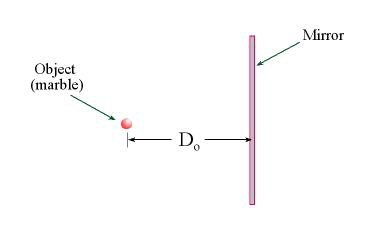
Figure 1.4
Light rays leaving any real object spread apart, or diverge, as they move away from the object. A set of light rays for the marble in front of the mirror is shown in Fig. 1.5 below. (There are many more rays that could be drawn—we only show a small sample of them here.)
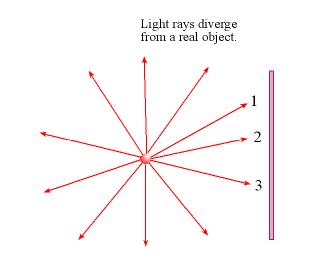
Figure 1.5
Of the light rays shown in Fig. 1.5, only three of them will actually make it to the mirror to be reflected—these rays have been labeled 1, 2, and 3. The other rays will hit the walls or other things in the room, so we will not be interested in them in the remainder of this discussion.
Let’s see what happens to the three rays of interest in Fig. 1.5 after they reach the mirror. In particular, let’s start off by looking carefully at ray 1. As shown in Fig. 1.6 below, this ray reaches the mirror at point A, where it is reflected.
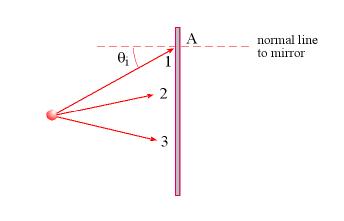
Figure 1.6
Since the ray reaches the air/mirror interface at point A, we draw a normal (a perpendicular line) to the mirror’s surface at point A (the dashed line in the figure). We can then measure the angle of incidence for ray 1 at point A, qi. This angle is also shown in Fig. 1.6.
We know from the Law of Reflection that the reflected ray must leave the mirror’s surface at an angle qr = qi as measured from the normal to the surface at point A. This reflected ray is shown in Fig. 1.7 below.
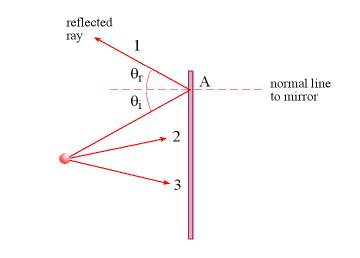
Figure 1.7
We can then follow this same procedure to draw in the reflected rays corresponding to the incident rays 2 and 3 at points B and C. These rays (without showing the corresponding normal lines and all of the angles) are shown in Fig. 1.8. Make sure that you see exactly why the reflected rays are drawn as they are (using the Law of Reflection)!
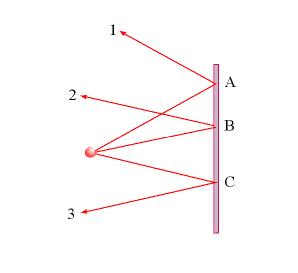
Figure 1.8
We are interested in studying the characteristics of the reflected rays, so, to help simplify the upcoming discussion, we redraw Fig. 1.8 without the marble and incident rays.
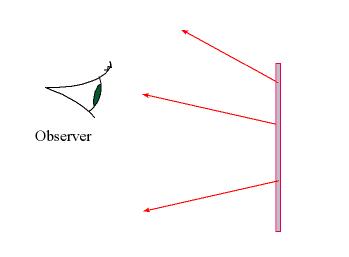
Figure 1.9
Let’s say that someone is now standing somewhere in front of the mirror and looking at the light from the marble after it is reflected off of the mirror. The person looking at the reflected light is called the observer, and is represented in Fig. 1.9 by the eye. We say that the observer is looking at the image of the object (the marble) in the mirror.
When an observer’s eye (with a brain attached!) looks at a light ray coming at it, it thinks that the ray is coming toward it along a straight-line path. Therefore, to see where the eye “thinks” the light ray is coming from, all we need to do is draw a line straight backward opposite to the direction the ray is traveling. This is done for the three rays reflected off of the mirror in Fig. 1.10.
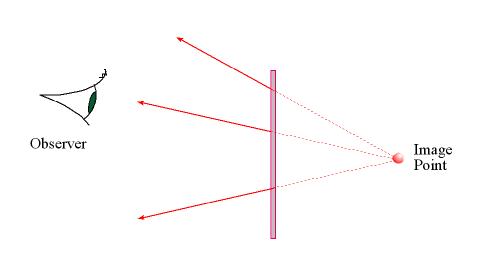
Figure 1.10
(Notice that the three rays are drawn dashed when we draw them behind the mirror—this is done to acknowledge the fact that no light actually travels in this region.) We notice that the three rays, when traced backwards, eventually intersect at the same point. This point is behind the plane mirror, and is called the image point. This is the point where our eye thinks the light rays are coming from—this is the position of the image seen by our eye. The (perpendicular) distance from the image point to the mirror is called the image distance, and is denoted Di. Fig. 1.11 shows the mirror along with the object, the object distance, the image (as seen by the observer), and the image distance.
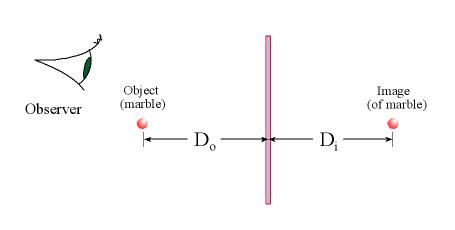
Figure 1.11
A bit of geometry (or measuring, if we do everything to scale) will show that the distance from the object (the marble) to the mirror is the same as the distance from the image to the mirror. We thus always have for a plane mirror that
Di = Do. Plane Mirror (1.13)
It’s important to keep in mind that, for a given object in front of a plane mirror, we can easily find the image of that object by drawing a line of length Do perpendicularly from the object to the mirror, and then continuing this line straight on the other side of the mirror for a distance Di = Do. The final point is the image point.