

The electron in a hydrogen atom is ordinarily in its lowest energy state – the ground state correspondong to the quantum state having principal quantum number n = 1, l = 0 and energy E1 (remember that an s-state is one for which l = 0; the value of l does not affect the energy within this formalism for hydrogen, however). The electron can be promoted to a higher energy state either by means of a collision or by absorbing a photon of energy Ephoton = hf, where the energy of the absorbed photon must match exactly the energy difference between the state the electron is currently in (usually but not always the ground state) and some higher quantum state (to which it will make a transition once the photon is absorbed). (We will only consider transitions involving the absorption or emission of photons.) Once in the higher energy state, the electron will drop down to some lower-energy state (not necessarily its original state!) in an attempt to return to the ground state. In making such a transition, two things must be true. The first is that the transition must obey the selection rule which says that a transition from some initial state to some final state (whether that final state is of higher or lower energy than the initial state doesn’t matter) can only occur if the orbital angular momentum quantum number changes by +1 or –1. That is, only those transitions for which Dl = ±1 are allowed transitions. The probability for a transition in other cases is zero. (There are other selection rules in atomic transitions that we will not mention here.)
The second thing that must be true for a transition to take place is that the energy difference |DEif| = |Ef – Ei| is emitted in the form of a singlephoton for the case in which the electron makes a transition to a lower energy state (Ef < Ei). On the other hand, a single photon of energy DEif must be absorbed in the case that Ef > Ei. From the Einstein relation for the energy of a photon, Ephoton = hf = hc/l, it then follows that the energies of possible photons emitted by the hydrogen atom must satisfy the equation
 |
(Since this equation does not rely on the details of the form of the equation for the energies as given in Eq. (9.6), this equation is in general true for any atom or molecule! As soon as we use Eq. (9.6), however, the result becomes true for hydrogen only. Such is the case for the following discussion.)
Combining Eqs. (9.6) and (9.8) gives us that, for a photon absorbed or emitted by a hydrogen atom,
 |
where the Rydberg constant R is as defined in Eq. (9.5). Solving Eq. (9.9) for one-over the wavelength, 1/l (this makes writing easier than solving for the wavelength itself...) then gives us that
 |
Equation (9.10) is a very important equation. It can be used to compute the wavelength of a photon that must be absorbed by an electron in a hydrogen atom in quantum state ni if it is to make a transition to the state nf. Likewise, it can be used to compute the wavelength of a photon that will be emitted by an electron in a hydrogen atom as it makes a transition from the quantum state ni to the state nf.
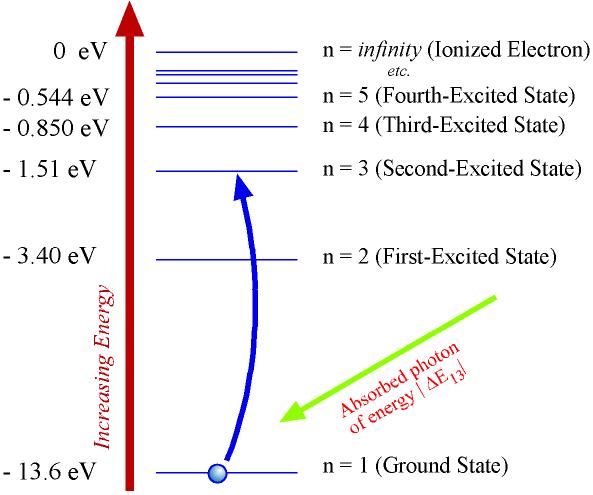
To possibly help clarify things, let’s consider a specific example. Let’s say that we have a hydrogen atom in its ground state, so that ni = 1. The electron in the atom absorbs a photon and makes a transition to the state nf = 3. We have already computed in the previous section that Ei = E1 = –13.6 eV, and that Ef = E3 = –1.51 eV. The change in energy is then |DEif| = |DE13| = |E3 – E1| = |(–1.51 eV) – (–13.6 eV)| = |12.09 eV| = 12.09 eV = 1.93×10⁻¹⁸ J. (Again, we have used the conversion factor from electron volts to joules: 1 eV = 1.6×10⁻¹⁹ J.) Thus, the electron would have to absorb a photon of energy Ephoton = |DE13| = 12.09 eV in order to undergo a transition from the ground state, n = 1, to the second-excited state, n = 3. This process is shown schematically in Fig. 9.2 below. (Remember that this diagram shows only energies of the allowed quantum states. The actual electron distribution around the nucleus in the various states is as described by the wavefunctions and the corresponding probability functions, as described earlier.)
|
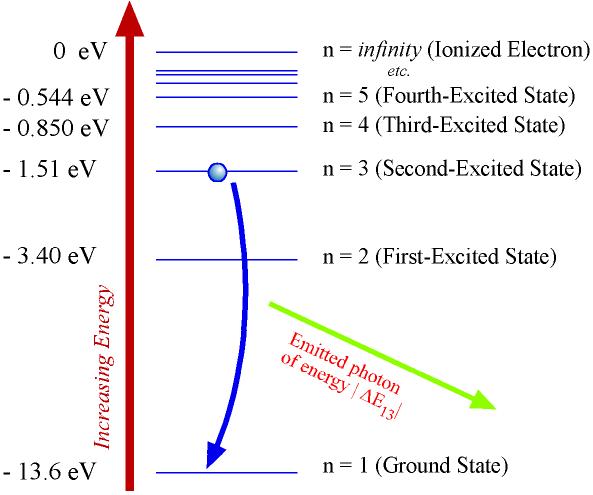
Likewise, if the electron in a hydrogen atom were already in the n = 3 state and were to undergo a transition down to the ground state (n = 1—note that it could also make a transition down to the n = 2 state and then, at possibly a later time, another transition from n = 2 down to n = 1...), it would emit a photon of energy Ephoton = |DE13| = 12.09 eV in the process. Fig. 9.3 below shows a schematic diagram of this process.
|
As electrons in excited states of various hydrogen atoms make transitions down to lower-energy states, they give off photons of various wavelengths, as dictated by Eq. (9.10). The group of various wavelengths thus emitted form what is called the emission spectrum for atomic hydrogen. (Likewise, the same wavelengths would be absorbed from a beam of radiation containing all possible wavelengths in the electromagnetic spectrum, such as a blackbody emission from a hot star, if that radiation were to pass through a gas of hydrogen atoms that were in various excited states. The corresponding spectrum would then be called the absorption spectrum.) The next example computes the wavelengths in the emission (or absorption) spectrum of atomic hydrogen for wavelengths in the visible region of the electromagnetic spectrum.